

Introduction
Freelancing used to sound like something reserved for seasoned professionals. Writers with published bylines, designers with fat portfolios, and developers with years of corporate polish defined that image. That perception, however, has quietly fallen apart. Today, thousands launch freelance careers with zero prior experience. They have no fancy credentials, just a laptop, curiosity, and the willingness to learn. They learn as they go. You’ve been eyeing remote work to earn online income. If you tell yourself you’re not qualified yet, this guide changes that mindset and provides a road map.
By the end of this article, you’ll understand why freelancing is more accessible than ever. You will learn how to get your first client, price your services, and grow a sustainable income. Even if you start from scratch, you’ll gain practical steps.
Why Freelancing No Longer Requires “Experience” in the Traditional Sense
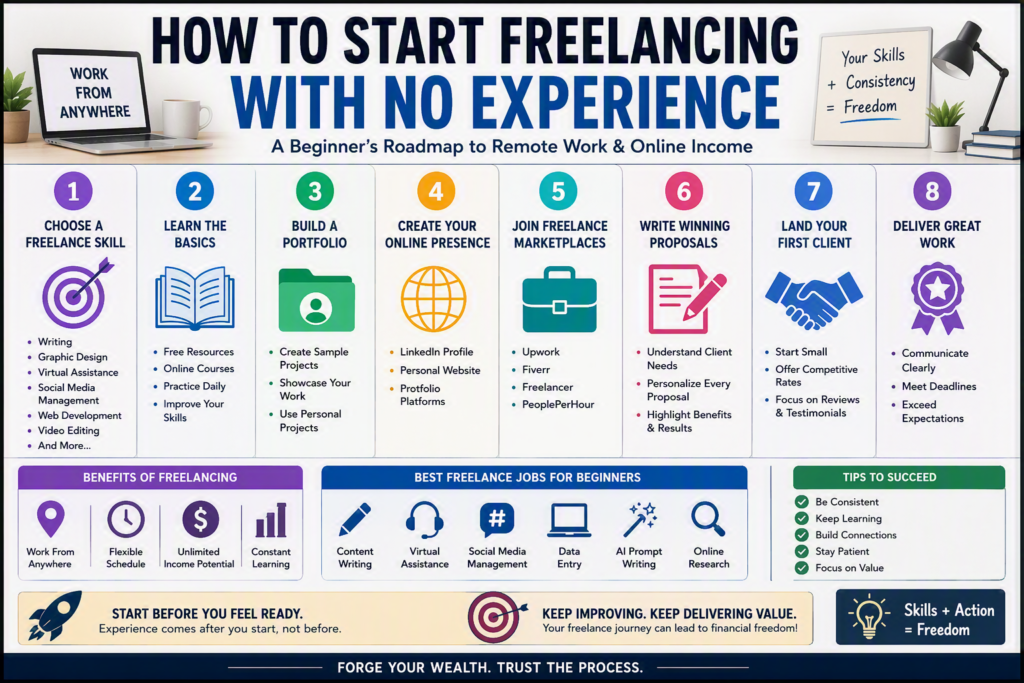
Let’s clear up a common misconception first: experience doesn’t only come from a job title. Experience comes from solving a problem, or demonstrating a skill. It can also come from producing a result, even without paid work.
Clients hiring freelancers aren’t usually interested in your resume. Freelancers’ clients aren’t usually interested in resumes. They care about three things. First, can you do the work; second, can you communicate clearly; third, can you deliver on time. That’s it. Someone who spent six months practicing graphic design on their own time can be hire able. That matches someone who studied it for four years if the output is the same.
This shift matters because it means your “lack of experience” is really just a lack of proof. And proof, unlike a decade of employment, can be built in weeks rather than years.
Step 1: Identify a Skill You Can Sell Today
Before worrying about platforms, portfolios, or pricing, you need to nail down what you’re actually offering. Many beginners stall here because they assume they need a rare or highly technical skill. In reality, plenty of in-demand freelance work is refreshingly ordinary. Consider:
- Writing — blog posts, product descriptions, email newsletters, or social media captions
- Virtual assistance — inbox management, scheduling, data entry, or customer support
- Graphic design — social media graphics, logos, or simple branding kits
- Video editing — short-form content for YouTube, TikTok, or Instagram Reels
- Web development — landing pages, WordPress setup, or simple bug fixes
- Translation — if you’re fluent in more than one language
- Bookkeeping — basic financial tracking for small businesses
- Voice over work — narration for ads, explained videos, or audio books
Notice that none of these require a formal degree. They require a reasonable level of competence. You can build it through free tutorials, practice projects, and repetition. Choose a skill that overlaps with something you already enjoy or are naturally decent at. Therefore, motivation tends to fade quickly when the work feels like a chore.
Step 2: Build Proof of Skill Before You Have Clients
Here’s where most beginners get stuck: “How do I get experience if no one will hire me without experience?” The answer is simpler than it sounds — you create your own experience.
Rather than waiting for a paying client to confirm your skills, take the initiative and create your own portfolio pieces. For example, if you enjoy writing, produce three or four high-quality blog posts on subjects you genuinely care about. Likewise, if design is your strength, develop branding concepts, logos, and marketing materials for fictional businesses. Alternatively, if you’re interested in software development, build a small application or website that addresses a real-world problem, even if it is a simple one. By creating sample projects, you demonstrate your abilities, gain practical experience, and build credibility before landing your first client. As a result, potential clients can evaluate your work immediately, making it easier to earn trust and secure paid opportunities.
This self-generated portfolio serves two purposes. First, it gives potential clients tangible evidence of what you can do, which matters far more to them than years of unrelated work history. Second, and just as importantly, it sharpens your actual skills through deliberate practice, so that when a real opportunity does arrive, you’re genuinely ready for it rather than faking confidence you don’t have.
Remember: Clients often hire based on proof of ability, not promises. Therefore, a strong portfolio can open doors long before you have professional experience.
Step 3: Choose the Right Platform to Launch On
Once you have a handful of sample projects, it’s time to put yourself in front of people who are actually looking to hire. Several platforms cater specifically to remote work and freelance beginners, each with its own strengths:
Upwork remains one of the largest freelance marketplaces, offering everything from one-off gigs to long-term contracts. Competition can be steep early on, so a sharp, specific profile description goes a long way.
Fiverr flips the traditional model — instead of applying to jobs, you create service listings (“gigs”) that clients browse and purchase directly. This works particularly well for clearly defined services like logo design or short video edits.
Freelancer.com functions similarly to Upwork, with a strong presence in more technical and administrative categories.
LinkedIn shouldn’t be overlooked either. Many businesses post freelance opportunities there, and simply optimizing your profile to reflect your new skill can attract inbound messages without you lifting a finger.
Niche communities, such as Facebook groups, Slack communities, or reddit tied to your specific skill, often yield warmer leads than large marketplaces, since the audience is smaller and more targeted.
Rather than spreading yourself across every platform simultaneously, pick one or two to focus on initially. Depth of effort on a single platform usually outperforms a shallow presence scattered everywhere.
Step 4: Craft a Profile That Sells Without Overselling
Your profile is essentially a mini sales pitch, and first impressions matter enormously in freelance marketplaces, where clients often scroll through dozens of options in minutes. A few principles make a noticeable difference:
Lead with the client’s problem, not your biography. Rather than opening with “I am a passionate writer who loves storytelling,” try something like, “I help small businesses turn complex ideas into blog posts their customers actually want to read.” This immediately signals value instead of forcing the reader to figure out how you’re useful to them.
Keep your language specific rather than vague. “I’m good with computers” says almost nothing; “I build responsive WordPress websites optimized for mobile users” says a great deal.
Include your sample work prominently, since portfolios build trust faster than any paragraph of self-description ever could. And finally, avoid over promising. Claiming expertise you don’t yet have often backfires once the work begins, whereas honest competence paired with strong communication tends to earn repeat business.
Step 5: Price Yourself Strategically, Not Desperately
Pricing is where new freelancers frequently trip themselves up, either by charging so little that the work feels unsustainable, or by pricing too high before they’ve built any track record. A more balanced approach works better in practice.
In the beginning, it’s reasonable to price slightly below market average, not as a permanent strategy, but as a deliberate tool to gather reviews, testimonials, and repeat clients quickly. Once you’ve completed a handful of projects successfully, gradually raise your rates. Most experienced freelancers didn’t start where they ended up; they built momentum first, then let their pricing catch up with their growing reputation.
Avoid the trap of charging by the hour when you’re inexperienced, since slower speed at the start can eat into your earnings and discourage you. Project-based or package pricing often works better, because it rewards efficiency rather than penalizing the learning curve you’re naturally going through.
Step 6: Land Your First Client
Getting that first paying client is often the hardest psychological hurdle, largely because it feels like proving yourself for the very first time. A few tactics tend to work particularly well for beginners:
Reach out directly instead of only waiting for job postings. Identify small businesses, startups, or creators who could plausibly use your service, and send a short, personalized pitch explaining how you could help them specifically — not generically.
Offer a small, low-risk starting project. Some beginners offer a discounted first project or even a free trial task in exchange for a testimonial. While working for free isn’t sustainable long-term, one strategic exception at the very start can open doors that would otherwise stay closed.
Leverage your existing network. Friends, former classmates, or even distant acquaintances often know someone who needs exactly what you offer. A simple message announcing your new freelance services can generate leads you wouldn’t find on any platform.
Respond quickly and professionally to any inquiry. Clients frequently choose based on responsiveness and clarity as much as skill level, especially among freelancers with similar experience.
Step 7: Deliver Exceptional Work and Ask for Feedback
Once you land that first project, treat it as more than just a paycheck — treat it as the foundation of your reputation. Communicate proactively, meet deadlines without needing reminders, and don’t hesitate to ask clarifying questions upfront rather than guessing and potentially missing the mark.
After completing the work, politely request a review or testimonial. Social proof compounds quickly; a handful of strong reviews early on can dramatically increase your chances of winning future projects, since new clients almost always look at what previous ones have said.
Step 8: Scale Gradually Into a Sustainable Income Stream
As you accumulate clients and confidence, your freelance work can evolve from a side hustle into a legitimate income source. A few strategies help make that transition smoother:
Diversify your client base so you’re never overly dependent on a single source of income. Losing one client shouldn’t feel catastrophic if you’ve spread your workload across several.
Systematize repetitive tasks, whether that’s using templates for proposals, automating invoicing, or creating a standard on boarding process for new clients. Efficiency frees up time for higher-value work.
Continue learning. Skills that felt advanced a year ago often become baseline expectations as the market evolves, so treat ongoing education as part of the job rather than an optional extra.
Finally, consider raising your rates periodically as your portfolio, reviews, and confidence grow. Many freelancers undervalue themselves indefinitely simply because they never revisit their original pricing.
Common Mistakes Beginners Should Avoid
A few pitfalls trip up new freelancers more often than almost anything else, so it’s worth naming them directly.
Trying to appeal to everyone rather than a specific niche often backfires, since vague positioning makes it harder for potential clients to understand exactly why they should choose you over someone else. Under pricing indefinitely, rather than as a short-term entry strategy, can also lead to burnout and resentment toward work that should otherwise feel rewarding. Ghosting or missing deadlines, even occasionally, damages trust far more severely in freelance work than in traditional employment, since your reputation is essentially your only asset. And neglecting contracts or clear written agreements, even for small projects, frequently leads to disputes over scope, payment, or revisions that could have been avoided with a simple written understanding upfront.
Final Thoughts
Starting a freelance career with no experience isn’t about pretending you know more than you do — it’s about proving what you can do, one project at a time. The freelancers who succeed aren’t necessarily the most talented from day one; they’re the ones who took action despite feeling under qualified, built proof through consistent practice, and treated every small project as a stepping stone toward something bigger.
Remote work and online income aren’t reserved for a lucky few anymore. With the right skill, a bit of self-generated proof, and consistent effort applied in the right places, freelancing offers a genuinely achievable path — regardless of where you’re starting from today.
Reference
Freelancing Platforms
- Upwork – Find freelance jobs and clients worldwide
https://www.upwork.com - Fiverr – Marketplace for freelance services
https://www.fiverr.com - PeoplePerHour – Freelance work and project opportunities
https://www.peopleperhour.com - Freelancer.com – Global freelancing platform
https://www.freelancer.com
Career and Freelancing Resources
- LinkedIn – Professional networking and client acquisition
https://www.linkedin.com - HubSpot Academy – Free courses on marketing, sales, and business development
https://academy.hubspot.com - Coursera – Online courses to build freelance skills
https://www.coursera.org - Google Digital Garage – Free digital skills and marketing training
https://learndigital.withgoogle.com
Remote Work Resources
- FlexJobs – Remote and flexible job opportunities
https://www.flexjobs.com - Remote.co – Remote work resources and job listings
https://remote.co - We Work Remotely – Remote job marketplace
https://weworkremotely.com
Portfolio Building Tools
- Notion – Create a simple professional portfolio
https://www.notion.so - Google Docs – Showcase writing samples and case studies
https://docs.google.com - WordPress – Build a freelance website and portfolio
https://wordpress.org - Canva – Design portfolios, resumes, and client presentations
https://www.canva.com
Related Articles
What Are the Best Tools for Email Automation? A Complete Guide to Choosing the Right Platform –




One thought on “How to Start Freelancing with No Experience”