

Introduction
Most people believe that earning more money automatically leads to financial success. Unfortunately, that is not always true. In fact, many individuals receive promotions, bonuses, and salary increases throughout their careers yet still struggle financially. Despite earning significantly more than they did years ago, they often find themselves living paycheck to paycheck with little savings and minimal investments. Why does this happen? The answer is often lifestyle inflation.
Lifestyle inflation is one of the most common and costly personal finance mistakes people make. Although it may seem harmless at first, it can quietly prevent wealth building and delay financial freedom for years.
Furthermore, because lifestyle inflation happens gradually, many people fail to recognize it until they are deeply trapped in a cycle of earning and spending.
Therefore, understanding how lifestyle inflation works—and more importantly, how to avoid it—is essential for anyone serious about building long-term wealth.
What Is Lifestyle Inflation?
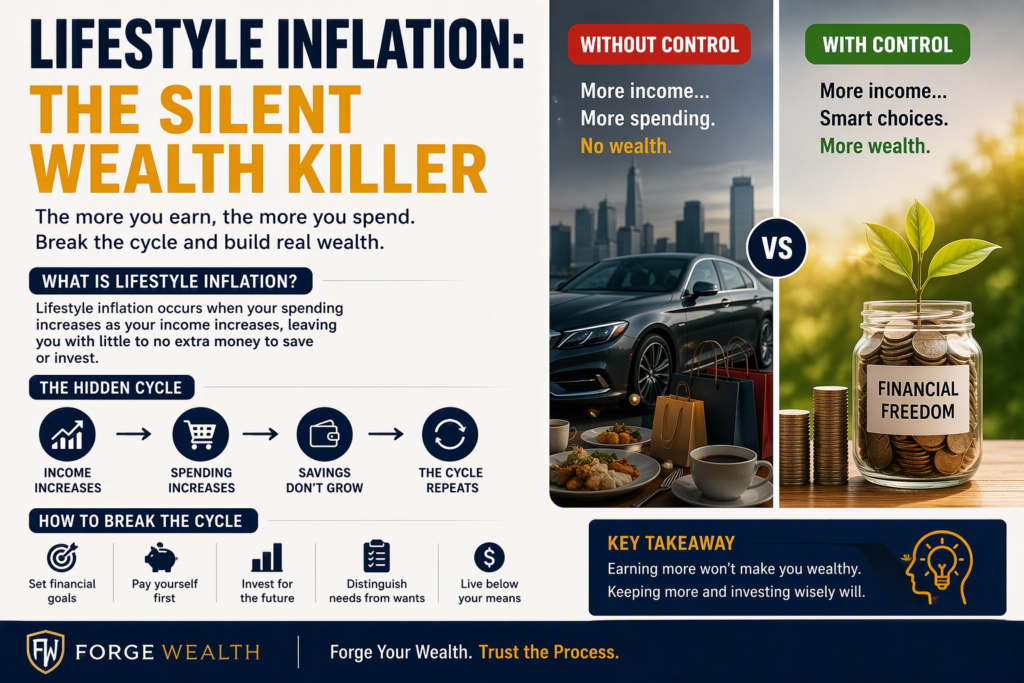
Lifestyle inflation occurs when spending increases as income increases.
In other words, every time you earn more money, your expenses rise along with it.
For example, imagine receiving a substantial raise at work.
Initially, you may plan to save or invest the extra income. However, after a few months, you decide to upgrade your car. Shortly afterward, you move into a larger apartment. Then you begin dining out more frequently, purchasing premium subscriptions, and taking more expensive vacations.
Before long, your higher income has been consumed by higher expenses.
As a result, you may not feel significantly wealthier despite earning much more money.
This is lifestyle inflation in action.
Why Lifestyle Inflation Is So Dangerous
At first glance, there seems to be nothing wrong with improving your quality of life.
After all, working hard should allow you to enjoy some of the rewards.
However, problems arise when spending grows at the same pace—or faster—than income.
Consequently, individuals miss valuable opportunities to:
- Build wealth
- Increase investments
- Grow emergency savings
- Reduce debt
- Achieve financial freedom
The danger is that lifestyle inflation often feels normal.
Rather than making one large purchase, people gradually increase spending over time.
Therefore, the impact can be difficult to notice.
Why High Earners Stay Broke
Many people assume high income automatically equals financial success.
Surprisingly, this is not always the case.
In fact, one of the biggest reasons why high earners stay broke is because their lifestyle expands alongside their income.
Consider two individuals:
Person A
- Earns $50,000 annually
- Saves 20% of income
- Lives below their means
Person B
- Earns $150,000 annually
- Spends nearly everything earned
- Carries debt
- Saves very little
Although Person B earns significantly more, Person A may actually be accumulating wealth faster.
Therefore, income alone does not determine financial success.
Rather, the gap between income and expenses is what truly matters.
The larger that gap becomes, the more money remains available for investing and wealth building.
Absolutely. Adding a Saving vs Spending Comparison Chart will make the article more visual, increase reader engagement, and strengthen the message about how lifestyle inflation impacts wealth building.
You can insert this section after:
“Why High Earners Stay Broke”
Saving vs Spending: The Real Difference Over Time
Many people believe that earning a high salary automatically leads to wealth. However, income alone is not what creates financial security. Instead, the difference between what you earn and what you spend determines your ability to build wealth.
Consider the following example:
Scenario Comparison
| Category | Person A (Saver) | Person B (Spender) |
|---|---|---|
| Annual Income | $100,000 | $100,000 |
| Annual Expenses | $60,000 | $95,000 |
| Annual Savings | $40,000 | $5,000 |
| Savings Rate | 40% | 5% |
| Investment Return | 8% | 8% |
Wealth Growth Over 10 Years
| Year | Person A (Saver) | Person B (Spender) |
|---|---|---|
| 1 | $40,000 | $5,000 |
| 3 | $129,856 | $16,232 |
| 5 | $234,657 | $29,332 |
| 10 | $624,229 | $78,029 |
Assumes an 8% annual return and consistent yearly contributions.
Key Insight
After just 10 years:
- The saver accumulates approximately $624,229
- The spender accumulates approximately $78,029
Despite earning exactly the same salary, the saver builds nearly 8 times more wealth simply by avoiding lifestyle inflation and prioritizing saving and investing.
Visual Chart
10-Year Wealth Growth
$700k ┤
$600k ┤ ███████████████████████████ Saver ($624k)
$500k ┤
$400k ┤
$300k ┤
$200k ┤
$100k ┤ ███ Spender ($78k)
$ 0 └────────────────────────────
The Hidden Cost of Lifestyle Inflation
Now imagine that every raise is spent rather than invested.
Example
Yearly Raise: $10,000
Invested for 20 Years at 8%:
≈ $494,000
Spent Instead:
≈ $0 Future Wealth
This is why lifestyle inflation is often called the silent wealth killer.
The problem is rarely one expensive purchase.
Rather, it is the accumulation of countless small decisions that slowly consume your future investment potential.
Wealth is not built by earning more alone. Wealth is built by increasing the gap between income and spending and allowing investments to compound over time.
Common Signs of Lifestyle Inflation
Many people experience lifestyle inflation without realizing it. Here are some warning signs.
Constantly Upgrading Everything
Every salary increase results in:
- A newer car
- A larger house
- More expensive gadgets
- Premium services
While occasional upgrades are reasonable, constantly increasing expenses can become problematic.
Living Paycheck to Paycheck Despite Higher Income
One of the clearest signs is earning substantially more money while still struggling to save.
If your income has increased significantly but your bank balance remains unchanged, lifestyle inflation may be responsible.
Increasing Debt Alongside Income
Some people increase spending so aggressively that they begin using credit cards and loans despite earning more money.
Consequently, financial stress actually increases rather than decreases.
Saving Less Than Expected
When raises disappear into discretionary spending, saving money becomes difficult even though income has improved.
This is one of the most overlooked personal finance mistakes.
Spending Too Much After a Raise
Receiving a raise is exciting.
Naturally, many people want to celebrate their success.
However, spending too much after a raise is one of the fastest ways to derail financial progress.
Consider this example:
Current Salary: $60,000
New Salary: $70,000
Salary Increase: $10,000
Instead of saving or investing the additional income, someone might:
- Upgrade their vehicle
- Move to a more expensive neighborhood
- Increase entertainment spending
- Add new subscriptions
As a result, their financial position changes very little despite earning more.
A smarter approach is to direct a significant portion of that raise toward:
- Investments
- Emergency savings
- Debt reduction
- Retirement accounts
This allows income growth to contribute to wealth growth.
The Psychology Behind Lifestyle Inflation
Lifestyle inflation is not simply a money problem.
In many cases, it is a behavioral issue.
Humans naturally adapt to improvements in circumstances.
What initially feels luxurious eventually feels normal.
For example:
A new car may feel exciting for several months.
Eventually, however, it becomes just another car.
Similarly, a larger home may seem amazing initially, yet over time it simply becomes your new standard.
This process is known as “hedonic adaptation.”
Consequently, people continue seeking new purchases in the hope of achieving greater happiness.
Unfortunately, this cycle can lead to persistent overspending.
How Lifestyle Inflation Prevents Wealth Building
Wealth building depends on one fundamental principle:
Income – Expenses = Wealth-Building Capacity
The more money you keep and invest, the faster your wealth grows.
However, when expenses rise every time income rises, that equation becomes less effective.
For example:
Scenario One
Income: $80,000
Expenses: $50,000
Savings: $30,000
Scenario Two
Income: $120,000
Expenses: $110,000
Savings: $10,000
Although the second individual earns considerably more, they are building wealth at a slower pace.
Therefore, controlling expenses often matters just as much as increasing income.
How to Avoid Lifestyle Inflation
Fortunately, lifestyle inflation can be controlled.
The key is creating intentional financial habits.
1. Pay Yourself First
Whenever you receive a raise, bonus, or commission, increase your savings before increasing your spending.
For example:
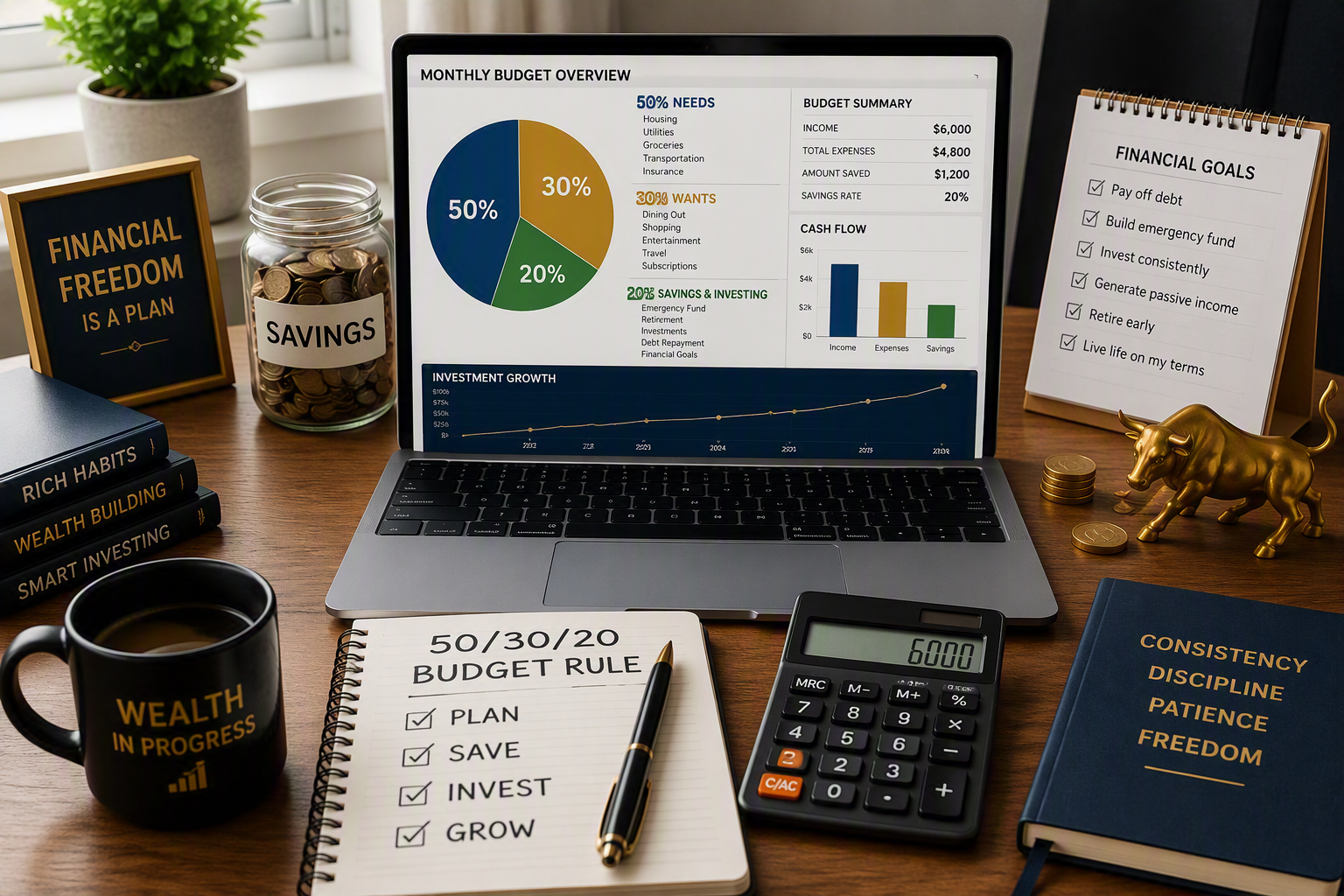
- 50% toward investing
- 30% toward savings
- 20% toward lifestyle improvements
This approach allows you to enjoy success while still prioritizing financial growth.
2. Automate Saving Money
Automation removes emotion from financial decisions.
Therefore, consider automatically transferring money to:
- Savings accounts
- Investment accounts
- Retirement plans
When money is saved first, you are less likely to spend it impulsively.
3. Set Clear Wealth-Building Goals
People who lack financial goals often spend whatever they earn.
In contrast, individuals with clear objectives tend to make better decisions.
Examples include:
- Saving for a home
- Building an emergency fund
- Achieving financial independence
- Reaching investment milestones
Goals create motivation and discipline.
4. Follow the 24-Hour Rule
Before making non-essential purchases, wait at least 24 hours.
For larger purchases, consider waiting even longer.
This simple habit reduces emotional spending significantly.
5. Increase Your Investments with Every Raise
A practical strategy is to automatically increase investment contributions whenever your salary increases.
For example:
If you receive a 5% raise, direct 3% toward investments and enjoy the remaining 2%.
Consequently, both your lifestyle and your wealth improve simultaneously.
6. Distinguish Wants from Needs
Not every expense improves your life.
Therefore, regularly ask yourself:
Does this purchase create genuine value or simply satisfy a temporary desire?
This question can prevent many unnecessary purchases.
Lifestyle Inflation vs Lifestyle Improvement
It’s important to understand that avoiding lifestyle inflation doesn’t mean avoiding lifestyle improvements.
There is a difference.
Healthy Lifestyle Improvement
- A safer home
- Better healthcare
- Professional development
- Family experiences
- Improved financial security
Lifestyle Inflation
- Constant status purchases
- Unnecessary luxury spending
- Expensive habits that provide little value
- Buying things simply to impress others
The goal is not to avoid spending entirely.
Rather, the goal is spending intentionally.
Building Wealth Without Sacrificing Everything
Many people believe wealth building requires extreme sacrifice.
Fortunately, that isn’t necessarily true.
Instead of drastically reducing your quality of life, focus on:
- Spending consciously
- Saving consistently
- Investing regularly
- Increasing income strategically
This balanced approach allows you to enjoy life today while preparing for tomorrow.
Consequently, you avoid both financial stress and financial regret.
Final Thoughts
Lifestyle inflation is often called the silent wealth killer for a simple reason: it quietly consumes income that could otherwise be used for building wealth.
Although earning more money is important, earning more while maintaining financial discipline is even more important.
Remember, wealth is not determined solely by how much you earn.
Rather, wealth is determined by how much you keep, save, and invest.
Therefore, the next time you receive a raise, bonus, or promotion, pause before increasing your spending.
Instead, ask yourself:
Will this decision improve my future, or simply increase my expenses?
The answer may have a significant impact on your long-term financial success.
“The goal isn’t to look wealthy. The goal is to become wealthy.”
References
- Investopedia – Lifestyle Inflation Guide
https://www.investopedia.com - Consumer Financial Protection Bureau (CFPB) – Saving and Budgeting Resources
https://www.consumerfinance.gov - Fidelity Investments – Wealth Planning and Savings Strategies
https://www.fidelity.com - Vanguard – Personal Finance and Investing Education
https://investor.vanguard.com - Charles Schwab – Financial Planning Resources
https://www.schwab.com
Related Article
Financial Freedom Roadmap: From Paycheck-to-Paycheck to Wealth Building – Forgewealth.org


3 thoughts on “Lifestyle Inflation: The Silent Wealth Killer”