
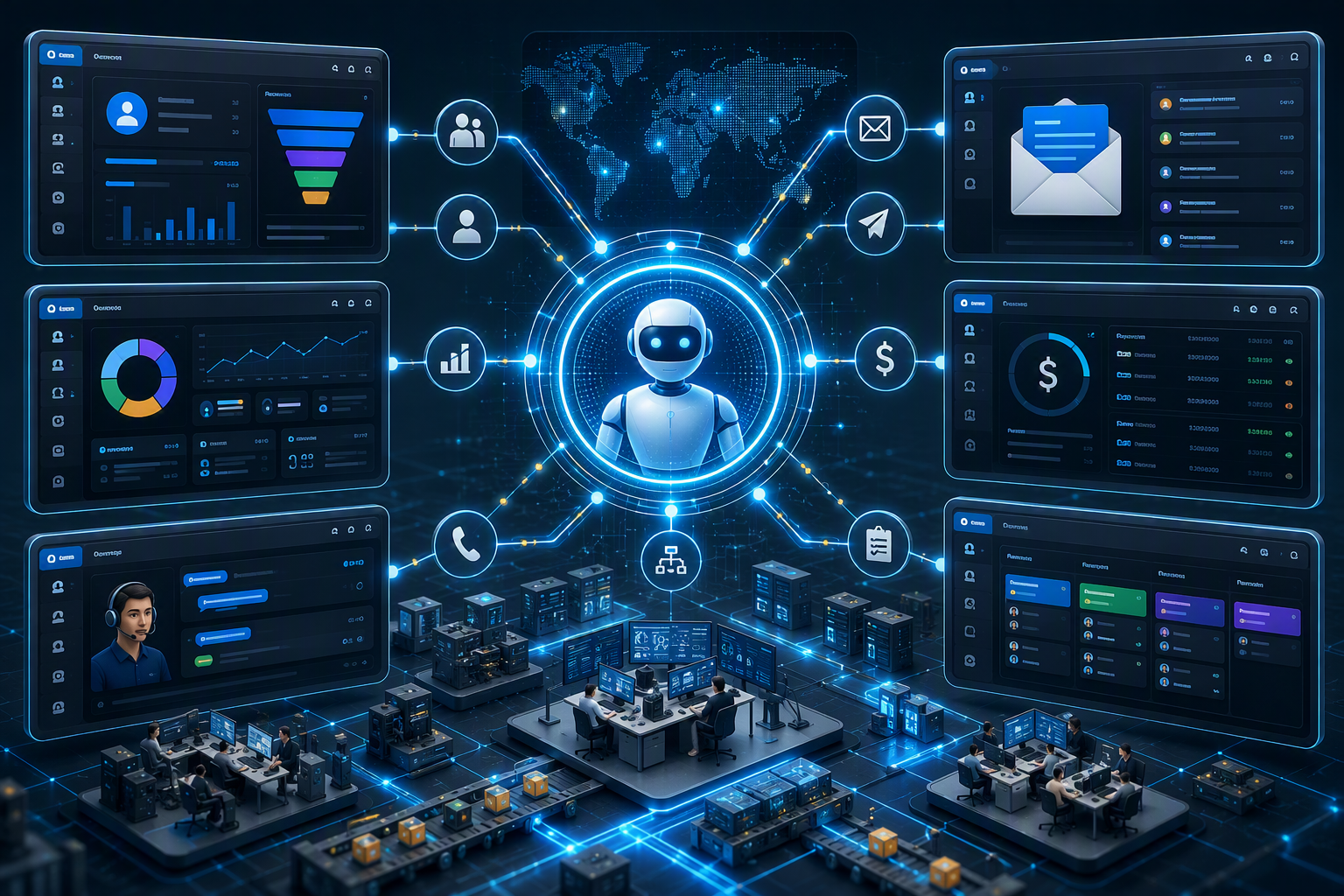
Discover how AI agents are transforming business, automating workflows, and reshaping the future of work. Learn why agentic AI is one of the biggest technology trends of 2026.
Introduction
Artificial Intelligence has already transformed the way people search for information, write content, analyze data, and communicate online. Over the past few years, tools such as ChatGPT, Claude, Gemini, and other AI assistants have helped millions of users complete tasks faster and more efficiently.
Yet, despite these impressive capabilities, most AI tools have traditionally functioned as assistants rather than independent workers. In other words, they could answer questions, generate reports, summarize documents, and even write code, but they still relied heavily on human direction every step of the way.
Now, a much bigger transformation is underway.
Instead of merely responding to prompts, a new generation of artificial intelligence is beginning to take action. These systems, commonly known as AI agents, can pursue goals, make decisions, coordinate multiple tasks, and complete entire workflows with limited human intervention. Consequently, many experts believe that AI agents will have a far greater impact on businesses than traditional chatbots ever did. [services.google.com], [techieclues.com]
Furthermore, organizations across industries are rapidly exploring how agentic AI can improve productivity, streamline operations, and reduce costs. At the same time, entrepreneurs are discovering new opportunities to automate processes that once required entire teams. As a result, AI agents are quickly becoming one of the most important technology trends heading into 2026. [aihandbook.io], [ceoworld.biz]
So, what exactly are AI agents, and why are so many business leaders paying attention?
Let’s take a closer look.
What Are AI Agents?
At first glance, an AI agent may appear similar to a chatbot. After all, both systems use artificial intelligence to understand instructions and generate responses.
However, there is a significant difference.
A traditional chatbot typically completes a single task. Once the chatbot provides an answer, the interaction ends. If another task is needed, the user must provide another instruction.
An AI agent, by contrast, is designed to achieve an objective rather than simply answer a question.
For example, imagine you’re planning a business trip.
A chatbot might explain how to book flights and hotels.
An AI agent, on the other hand, could:
- Search for available flights
- Compare prices
- Book accommodations
- Schedule meetings
- Organize transportation
- Generate an itinerary
- Send calendar invitations
without requiring step-by-step instructions for every action.
In essence, AI agents focus on outcomes instead of individual tasks.
As a result, businesses are beginning to view AI not merely as a productivity tool but as a workforce multiplier.
From Chatbots to Agentic AI
To fully appreciate the significance of AI agents, it helps to understand how artificial intelligence has evolved.
The First Phase: Information Retrieval
Initially, AI systems excelled at finding information.
For instance, they could answer questions, summarize text, and retrieve data from large knowledge bases.
Although this represented a major advancement, human users still needed to interpret and act upon the information.
The Second Phase: Content Generation
Next came generative AI.
During this phase, AI gained the ability to create content, including:
- Articles
- Images
- Videos
- Code
- Marketing copy
- Presentations
As a result, workers became more productive because repetitive tasks could be completed significantly faster.
Even so, humans remained responsible for managing workflows and coordinating activities.
The Third Phase: Agentic AI
Today, we are entering the era of agentic AI.
Unlike previous AI systems, AI agents are designed to understand goals, create plans, execute actions, and continuously evaluate progress.
Consequently, businesses can automate entire workflows rather than individual tasks. Furthermore, organizations can integrate AI agents directly into customer service platforms, sales systems, financial software, and operational processes. [ceoworld.biz], [aihandbook.io]
This shift is important because it changes AI from a helpful assistant into an active participant within business operations.
Why AI Agents Matter More Than Traditional Automation
For decades, companies have used automation to improve efficiency.
Nevertheless, traditional automation has always had limitations.
Typically, automation systems rely on predefined rules. If a process changes unexpectedly, the automation often fails and requires manual intervention.
AI agents operate differently.
Rather than following rigid instructions, they can analyze situations, adapt to changing circumstances, and determine the most effective path toward a goal.
For example, a traditional automation system might process invoices using fixed rules.
Meanwhile, an AI agent could:
- Review invoices
- Detect anomalies
- Compare historical trends
- Recommend actions
- Escalate problems when necessary
without being programmed for every possible scenario.
Therefore, AI agents introduce a level of flexibility that traditional automation simply cannot provide.
As a result, many experts view agentic AI as the next major leap in AI automation. [services.google.com], [techieclues.com]
Why Businesses Are Investing in AI Agents
There are several reasons why companies are aggressively exploring AI agents.
First and foremost, businesses are under constant pressure to improve efficiency.
At the same time, customers expect faster service, employees need better tools, and leadership teams are searching for ways to reduce operational expenses.
Consequently, AI agents offer an attractive solution.
For instance, AI agents can work around the clock. Additionally, they can process vast amounts of information within seconds. Just as importantly, they can perform repetitive administrative tasks that often consume valuable employee time.
Because of these advantages, organizations are increasingly incorporating AI directly into business workflows rather than treating it as an experimental technology. In fact, many analysts believe AI is transitioning from standalone applications to embedded business infrastructure. [aihandbook.io], [ceoworld.biz]
Moreover, AI agents make advanced capabilities accessible to smaller businesses. In the past, only large enterprises could afford sophisticated software systems and specialized teams. Today, however, AI is helping entrepreneurs and small organizations compete more effectively in the marketplace. [powerhomebiz.com]
References
- Google Cloud – AI Agent Trends 2026 [services.google.com]
- AI Handbook – Generative AI Trends in 2026 [aihandbook.io]
- CEOWORLD Magazine – Generative AI Business Trends 2026 [ceoworld.biz]
- TechieClues – Top Generative AI Trends for 2026 [techieclues.com]
- PowerHomeBiz – Top Generative AI Trends Small Businesses Should Watch in 2026 [powerhomebiz.com]
Related Article
The Biggest AI Business Mistakes to Avoid in 2026 (And How to Fix Them) – forgewealth.org



One thought on “From Chatbots to AI Agents: Next Big Leap in AI Tech”