

Introduction
Artificial Intelligence is no longer a futuristic concept reserved for technology companies and research laboratories. Instead, AI has become part of everyday life. From virtual assistants and recommendation algorithms to automated customer support and content creation tools, artificial intelligence is transforming how individuals work and how businesses operate.
As a result, discussions surrounding AI and jobs have become increasingly common. Employees are wondering whether their careers remain secure. Students are questioning which future careers are worth pursuing. Meanwhile, business leaders are evaluating how AI automation can improve productivity while reducing operational costs.
However, despite the alarming headlines often seen online, the reality is far more nuanced.
While AI will undoubtedly automate certain tasks, it is unlikely to eliminate the need for human talent entirely. In fact, throughout history, technological advancements have consistently changed the nature of work rather than removing work altogether. Therefore, instead of focusing solely on job losses, it is equally important to understand how the workforce is evolving and where new opportunities are emerging.
Consequently, the real question is not whether AI will affect employment. Rather, the question is:
Which careers are most vulnerable to AI automation, which professions are likely to survive, and what high-income skills should people develop to remain competitive?
Let’s explore the answers.
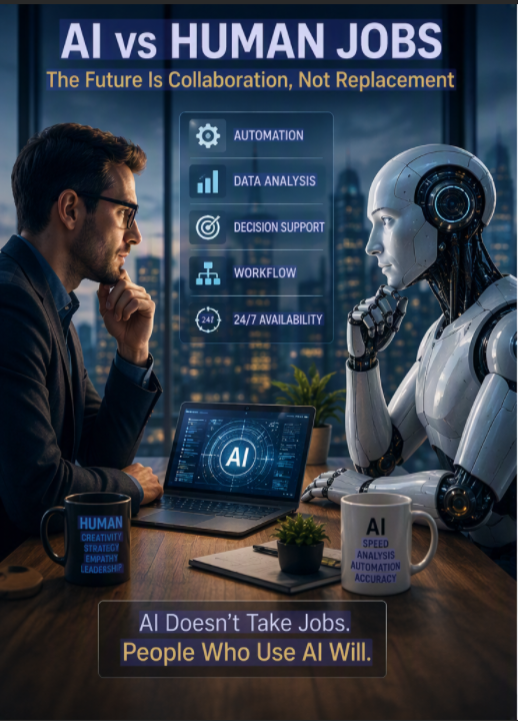
The Relationship Between AI and Jobs
To understand the future of employment, it is essential to understand what AI does well and where its limitations still exist.
Generally speaking, AI excels at tasks that are:
- Repetitive
- Predictable
- Data-driven
- Rule-based
- Process-oriented
For example, AI can analyze thousands of documents within seconds. Likewise, it can identify patterns in data much faster than humans. Additionally, AI can automate routine tasks without becoming tired or distracted.
However, AI struggles whenever tasks require:
- Emotional intelligence
- Human relationships
- Creativity
- Complex judgment
- Leadership
- Ethical decision-making
Therefore, jobs focused primarily on routine activities face greater disruption than jobs requiring human insight and interpersonal skills.
In other words, AI is replacing tasks faster than it is replacing entire professions.
Why This Wave of Automation Is Different From previous AI Generations
Every generation experiences technological change.
For instance:
- The Industrial Revolution transformed manufacturing.
- Computers transformed administration.
- The internet transformed communication and commerce.
Initially, each innovation created fear. Nevertheless, while some jobs disappeared, entirely new industries emerged.
Similarly, today’s AI revolution follows a familiar pattern.
However, there is one important difference.
Unlike previous technologies that mainly automated physical work, AI automation is increasingly automating cognitive tasks.
Consequently, professions traditionally considered “safe” from automation are now experiencing disruption.
At the same time, new opportunities are appearing faster than ever before.
Therefore, adaptability is becoming one of the most valuable career traits.
Jobs Most Affected by AI Automation
Some professions are significantly more exposed to automation than others.
Let’s take a closer look.
1. Data Entry and Administrative Processing
Data entry jobs have long involved repetitive tasks.
Employees often:
- Transfer information
- Update records
- Process forms
- Organize databases
Today, AI systems can perform these functions with impressive speed and accuracy.
As a result, companies are increasingly automating these workflows.
Consequently, demand for traditional data-entry positions is expected to decline over time.
This does not mean every administrative role will disappear. However, the nature of administrative work is likely to change significantly.
2. Basic Customer Service Positions
Customer service teams are already experiencing the impact of AI automation.
For example, AI-powered chatbots can:
- Answer common questions
- Track orders
- Process returns
- Provide account information
Furthermore, AI systems are becoming increasingly sophisticated.
As a result, businesses can handle larger volumes of routine inquiries without hiring additional staff.
Nevertheless, complex customer issues still require human judgment, empathy, and problem-solving.
Therefore, customer service professionals who specialize in relationship-building and complex support will remain valuable.
3. Routine Content Creation
Generative AI can now produce:
- Product descriptions
- Basic blog posts
- Social media captions
- Promotional content
Consequently, some entry-level content creation jobs are becoming more competitive.
However, there is an important distinction.
While AI can generate words, it cannot easily replicate expertise, authority, unique experiences, and strategic thinking.
Therefore, skilled writers, editors, researchers, and content strategists will continue to play important roles.
4. Basic Bookkeeping
AI tools can automate numerous financial tasks including:
- Expense classification
- Invoice processing
- Account reconciliation
- Transaction tracking
Because of this, traditional bookkeeping functions are becoming increasingly automated.
Nevertheless, financial advisors, analysts, and strategic accountants remain in demand because businesses still require human interpretation and decision-making.
5. Repetitive Manufacturing Tasks
Automation has transformed manufacturing for decades.
Now, AI-powered robots can perform even more responsibilities, including:
- Quality inspections
- Inventory tracking
- Assembly processes
- Process optimization
Therefore, repetitive factory jobs face continued automation pressure.
However, roles involving supervision, maintenance, engineering, and system management remain important.
Jobs That Are Likely to Survive AI
Although AI is transforming many industries, several professions possess characteristics that make full automation unlikely.
Let’s explore these careers.
1. Healthcare Professionals
Healthcare depends heavily on human interaction.
Doctors, nurses, therapists, and healthcare specialists must:
- Build trust
- Interpret complex situations
- Communicate effectively
- Make life-affecting decisions
While AI can assist with diagnosis and analysis, patients still value human care.
Furthermore, healthcare situations often involve variables that are difficult to standardize.
Therefore, healthcare remains one of the strongest future career paths.
2. Skilled Trades
Many people assume office jobs are safer than physical labor.
Ironically, the opposite may be true.
Electricians, plumbers, HVAC technicians, mechanics, and construction specialists work in dynamic environments where every situation is different.
As a result, automating these professions is significantly more challenging.
Consequently, skilled trades are expected to remain highly valuable for decades.
3. Leadership and Management
Leadership requires qualities that AI cannot easily replicate.
For example, leaders must:
- Inspire teams
- Resolve conflicts
- Make strategic decisions
- Manage uncertainty
Additionally, businesses rely on leaders to shape culture and vision.
Therefore, leadership positions are likely to become even more important as organizations adopt AI technologies.
4. Sales and Business Development
Sales remains fundamentally human.
Although AI can analyze customer data and identify opportunities, successful sales often depend on:
- Trust
- Persuasion
- Relationship-building
- Negotiation
Consequently, high-performing sales professionals will continue to command strong demand.
5. Education and Training
Learning involves much more than delivering information.
Educators also:
- Encourage growth
- Adapt teaching methods
- Provide mentorship
- Develop critical thinking
As a result, teachers, coaches, trainers, and mentors remain difficult to replace.
While AI may support education, human guidance will continue to play a critical role.
High-Income Skills Worth Learning
Rather than focusing solely on specific careers, it is often smarter to focus on developing high-income skills.
After all, skills are transferable.
Jobs change.
Industries evolve.
However, valuable skills remain useful in almost every economy.
AI Literacy
Understanding AI is quickly becoming essential.
You don’t need to become a machine learning engineer. However, you should understand:
- AI tools
- AI workflows
- AI automation
- Prompt engineering
- AI productivity systems
The ability to work alongside AI will likely become one of the most important workplace advantages.
Communication
Communication remains one of the most underrated high-income skills.
Individuals who communicate effectively can:
- Lead teams
- Close sales
- Build relationships
- Influence decisions
Furthermore, communication becomes even more valuable as automation increases.
Critical Thinking
AI can generate information.
However, evaluating information remains a human responsibility.
Therefore, professionals who can assess risks, identify flaws, and make sound decisions will remain highly valuable.
Problem Solving
Businesses pay people to solve problems.
Therefore, individuals who consistently identify solutions will continue to thrive regardless of technological change.
Digital Marketing
Businesses always need visibility.
Consequently, skills such as:
- SEO
- Email marketing
- Content strategy
- Marketing analytics
- Brand development
remain highly valuable.
Better still, AI can help marketers become more productive without replacing strategic thinking.
Sales and Negotiation
No matter how advanced technology becomes, businesses still need customers.
Therefore, sales skills remain among the most profitable and future-proof abilities a person can develop.
Financial Literacy
As readers of ForgeWealth already know, financial literacy is invaluable.
Individuals who understand:
- Investing
- Budgeting
- Wealth-building
- Financial planning
are better positioned to create opportunities and navigate economic uncertainty.
The Future Careers Created by AI
While many discussions focus on jobs being lost, fewer conversations focus on jobs being created.
Yet new opportunities are emerging rapidly.
Examples include:
AI Consultant
Helping organizations implement AI solutions.
AI Trainer
Teaching teams how to use AI effectively.
Automation Specialist
Designing workflows that integrate AI tools.
Prompt Engineer
Creating optimized instructions and systems for AI.
AI Governance Specialist
Ensuring responsible and compliant AI deployment.
Cybersecurity Professional
Protecting organizations from increasingly sophisticated digital threats.
Consequently, AI is not only changing careers—it is creating entirely new professions.
How to Future-Proof Your Career
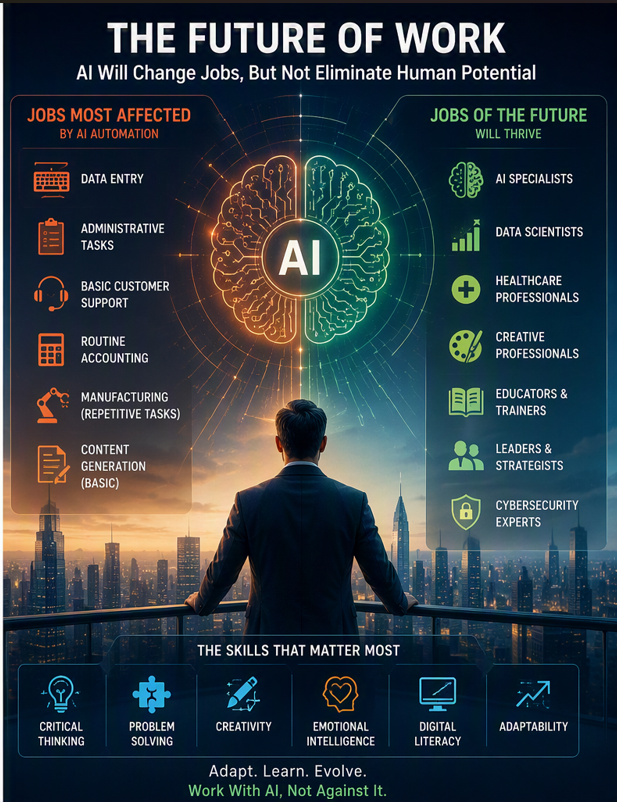
According to the World Economic Forum’s Future of Jobs Report, technological advancements including artificial intelligence are expected to transform millions of jobs while simultaneously creating new opportunities in emerging industries.
The future is impossible to predict perfectly.
Nevertheless, there are practical steps anyone can take.
Never Stop Learning
The most successful professionals continuously adapt.
Therefore, lifelong learning should become part of your career strategy.
Embrace Technology
Rather than fearing AI, learn how to leverage it.
Workers who understand AI often outperform equally talented workers who ignore it.
Build Multiple Income Streams
Depending on a single source of income can be risky.
Therefore, consider developing:
- Freelancing income
- Investments
- Side hustles
- Digital products
- Consulting services
Multiple income streams increase financial resilience.
Focus on Value Creation
Ultimately, the marketplace rewards value.
Therefore, ask yourself:
What problems can I solve that others cannot?
The better your answer, the stronger your career prospects.
Final Thoughts
The conversation around AI and jobs often focuses on fear.
However, history suggests a more balanced perspective.
Yes, AI automation will transform many industries.
Yes, some tasks will disappear.
Yet, at the same time, new professions, opportunities, and future careers are emerging.
Therefore, the goal should not be resisting change. Instead, the goal should be adaptation.
Individuals who develop high-income skills, embrace lifelong learning, and learn to work alongside AI will be well-positioned for success.
Ultimately, the future belongs to people who combine technology with uniquely human strengths such as creativity, empathy, communication, leadership, and critical thinking.
Remember:
AI is not replacing human potential. Instead, it is reshaping how human potential creates value.
We believe that the most successful people of the future will not be those who fear change. Rather, they will be those who learn, adapt, and grow with it.
References & Further Reading
Artificial Intelligence and the Future of Jobs
- World Economic Forum (WEF) – Future of Jobs Report
- https://www.weforum.org/reports/the-future-of-jobs-report
- Provides insights into emerging jobs, workforce transformation, and the impact of AI on employment.
- McKinsey Global Institute – The Economic Potential of Generative AI
- https://www.mckinsey.com
- Discusses how AI automation is affecting industries and creating new productivity opportunities.
- International Monetary Fund (IMF) – AI and the Future of Work
- https://www.imf.org
- Examines the impact of artificial intelligence on labor markets and economic growth.
AI Automation and Agentic AI
- Google Cloud – AI Agent Trends 2026 Report
- https://cloud.google.com
- Explains how AI agents are transforming workflows and business operations.
- Microsoft Work Trend Index
- https://www.microsoft.com/worklab
- Research on AI adoption, workplace transformation, and employee productivity.
- IBM AI Insights
- https://www.ibm.com/artificial-intelligence
- AI implementation trends, automation strategies, and workforce impact.
Skills and Future Careers
- LinkedIn Economic Graph
- https://economicgraph.linkedin.com
- Data-driven research on emerging skills and future career opportunities.
- Coursera Job Skills Report
- https://www.coursera.org
- Analysis of high-demand skills in technology, business, and AI.
- Harvard Business Review
- https://hbr.org
- Articles on leadership, management, innovation, and adapting to workplace changes.
Cybersecurity and Technology Careers
- ISC² Cybersecurity Workforce Study
- https://www.isc2.org
- Research on cybersecurity workforce demand and career opportunities.
- Bureau of Labor Statistics (BLS)
- https://www.bls.gov
- Employment projections and fastest-growing occupations.
Related Articles
From Chatbots to AI Agents: Next Big Leap in AI Tech – forgewealth.org
The Biggest AI Business Mistakes to Avoid in 2026 (And How to Fix Them) – forgewealth.org




One thought on “AI Technology Which Careers Are Safe in the Age of Automation?”