

Introduction
Imagine waking up to find money deposited into your investment account—not because you worked extra hours, completed additional projects, or started a new side hustle, but because you own shares in businesses that reward investors regularly. That is the power of dividend investing.
While many investors focus exclusively on buying stocks that may increase in value over time, dividend investors pursue a different objective. Instead of relying solely on capital appreciation, they build portfolios designed to produce consistent income.
As a result, dividend investing has become one of the most popular strategies for individuals seeking financial independence, retirement security, and long-term wealth. Dividend-paying companies often have established business models, steady cash flows, and proven track records. Making, many investors view dividend stocks as a practical way to generate income while maintaining exposure to stock market growth.
Investing can benefit both beginners and experienced investors. On one hand, newcomers appreciate the simplicity of receiving regular cash payments. On the other hand, seasoned investors value the compounding effect that dividends can create over time.
But, many people still wonder:
Can dividend stocks really generate meaningful passive income?
More importantly:
How do dividends generate income, and what is the best dividend investing strategy for long-term success?
Let’s take a closer look.
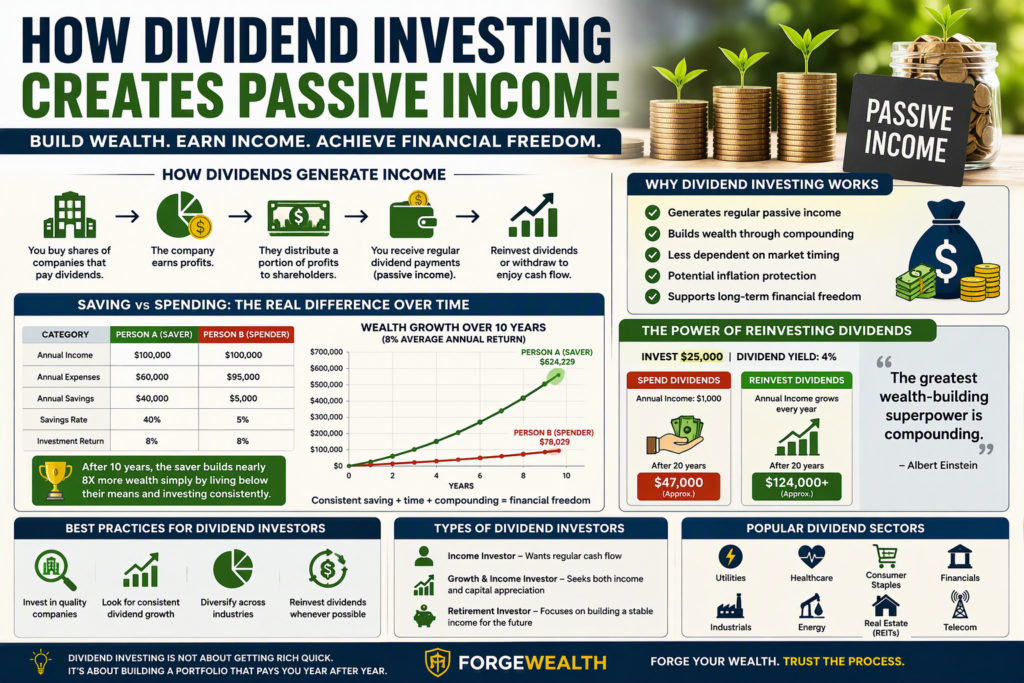
What Is Dividend Investing?
Dividend investing is the practice of purchasing shares in companies that distribute a portion of their profits to shareholders through regular payments called dividends.
Simply put, when a business earns profits, management can choose to:
- Reinvest profits into the company
- Pay down debt
- Repurchase shares
- Distribute dividends to shareholders
Many mature and financially stable companies choose to reward investors through dividends. By owning shares in these businesses, investors become eligible to receive a portion of those profits.
Unlike a traditional savings account that pays interest, dividend stocks generate returns through both dividend payments and potential increases in share price. With this, investors benefit from two potential sources of growth.
Understanding Dividend Stocks
Before diving deeper into dividend investing, it’s important to understand what dividend stocks are.
A dividend stock is simply a stock that pays dividends to shareholders on a regular basis. Typically, dividend-paying companies operate in industries that generate consistent revenue.
For example:
- Consumer goods
- Healthcare
- Utilities
- Telecommunications
- Financial services
- Energy
Because these businesses often produce predictable cash flows, they can distribute a portion of their earnings to investors while continuing to operate and grow.
As a result, dividend stocks have become a cornerstone of many wealth-building strategies.
Furthermore, investors often appreciate the stability these companies can provide, particularly during periods of market uncertainty.
How Dividends Generate Income
One of the most frequently asked questions among beginner investors is:
How do dividends generate income?
Fortunately, the process is relatively straightforward.
First, you invest in shares of a company that pays dividends.
Next, the company announces a dividend payment.
Then, as long as you own the shares before the required record date, you receive your portion of the dividend.
For example:
Annual Dividend Per Share = $3
Shares Owned = 1,000
Dividend Income = $3,000 Per Year
In this scenario, the investor earns $3,000 annually without selling any shares.
Consequently, the investment creates a stream of income while maintaining ownership of the underlying asset.
This is precisely why dividend investing is considered a form of passive income investing.
The investments continue working even when the investor is not actively working.
Why Dividend Investing Appeals to Wealth Builders
Dividend investing continues to attract long-term investors for several compelling reasons.
While no investment strategy is perfect, dividend investing offers benefits that many other approaches cannot easily provide.
1. Regular Passive Income
Perhaps the most obvious advantage is recurring income. Unlike growth stocks, which may only generate profits when sold, dividend stocks can produce ongoing cash flow, giving investors the opportunity to receive compensation simply for remaining shareholders.
Over time, this income can help pay for:
- Household expenses
- Mortgage payments
- Travel
- Retirement costs
- Reinvestments
Truely, dividend investing can become an important component of financial freedom.
2. Long-Term Wealth Building
Although many people associate dividends primarily with income, dividend investing is also a powerful wealth-building strategy.
In fact, reinvested dividends can significantly accelerate portfolio growth. Each dividend payment can purchase additional shares.
Then, those additional shares generate more dividends. Subsequently, those dividends purchase even more shares. As this cycle continues, compounding begins to work in your favor. Therefore, investors who remain consistent often experience substantial portfolio growth over the long term.
3. Reduced Dependence on Market Timing
Many investors worry about market fluctuations. However, dividend investors often focus more on income generation than short-term price movements.
As long as the underlying companies remain financially healthy, dividend payments may continue even during periods of volatility. This allows investors focus on long-term objectives rather than daily market noise.
4. Growing Income Streams
Some companies increase their dividend payments regularly. As a result, investors may enjoy rising income without purchasing additional shares.
For example:
Year 1 Dividend = $1.50 per share
Year 5 Dividend = $2.25 per share
Year 10 Dividend = $3.50 per share
Therefore, income can increase over time even if the investor does nothing beyond holding their shares.
Dividend Investing for Beginners
If you’re new to investing, dividend investing can provide an accessible entry point into the stock market., however, success requires more than simply buying random dividend-paying stocks. Instead, investors should follow a structured approach.
Step 1: Open an Investment Account
Before purchasing stocks, you’ll need a brokerage account.
Fortunately, many modern platforms allow investors to start with relatively small amounts of money.
Once the account is established, you can begin researching dividend opportunities.
Step 2: Research Quality Companies
Not all dividend stocks are created equal.
Therefore, it’s important to evaluate:
- Revenue growth
- Profitability
- Debt levels
- Dividend history
- Cash flow
Generally speaking, companies with strong fundamentals are more likely to maintain and increase dividend payments over time.
Step 3: Diversify Your Portfolio
Although a single stock may appear attractive, relying too heavily on one investment increases risk.
Instead, spread investments across multiple sectors.
For example:
- Utilities
- Healthcare
- Consumer staples
- Financial institutions
- Industrial companies
Consequently, your income stream becomes more resilient.
Step 4: Reinvest Early
For younger investors, reinvesting dividends often makes the most sense.
Rather than spending the income immediately, allow dividends to purchase additional shares.
As a result, compounding can dramatically increase future returns.
The Magic of Dividend Reinvestment
Perhaps the greatest advantage of dividend investing is the ability to compound returns.
Let’s examine a simplified example.
Investor A
Investment = $25,000
Dividend Yield = 4%
Annual Income = $1,000
Spends all dividend payments annually.
Investor B
Investment = $25,000
Dividend Yield = 4%
Annual Income = $1,000
Reinvests every dividend payment.
Initially, the difference seems minimal.
However, year after year, Investor B acquires additional shares.
Consequently, future dividend payments become larger.
Eventually, the gap between the two investors can become substantial.
Therefore, reinvestment is often considered one of the best dividend investing strategies for long-term wealth creation.
What Is Dividend Yield?
Dividend yield helps investors estimate how much income a stock produces relative to its market price.
The formula is:
Dividend Yield =
Annual Dividend ÷ Share Price
For example:
Annual Dividend = $5
Stock Price = $100
Dividend Yield = 5%
This means an investor receives approximately $5 annually for every $100 invested.
However, yield should never be the only factor considered.
While high yields may appear attractive, they can sometimes signal underlying business challenges.
Therefore, quality, stability, and dividend sustainability should remain priorities.
The Best Dividend Investing Strategy
Many investors search for the perfect dividend investing strategy.
Although no strategy guarantees success, several principles consistently prove valuable.
Focus on Dividend Growth
Rather than chasing the highest yields, consider companies with a history of increasing payouts.
As dividends grow, income often grows alongside them.
Consequently, long-term investors benefit from rising cash flow.
Prioritize Financial Strength
A company’s ability to sustain dividends depends largely on its financial health.
Therefore, focus on businesses with:
- Strong earnings
- Healthy cash flow
- Manageable debt
- Solid competitive advantages
Invest Consistently
Rather than waiting for the perfect opportunity, many successful investors contribute regularly.
Consequently, they benefit from dollar-cost averaging and long-term market growth.
Think Long Term
Dividend investing is rarely a get-rich-quick strategy.
Instead, it rewards patience, consistency, and discipline.
Therefore, maintaining a long-term perspective is essential.
Common Dividend Investing Mistakes
Even good strategies can fail if common mistakes are ignored.
Chasing High Yields
A double-digit yield may appear attractive.
However, unusually high yields can sometimes indicate financial stress.
Therefore, investigate the company thoroughly before investing.
Ignoring Company Fundamentals
Dividends are important.
Nevertheless, the underlying business matters even more.
A strong company usually supports a strong dividend program.
Failing to Diversify
Concentrating investments in one company or industry increases risk.
Consequently, diversification remains essential.
Making Emotional Decisions
Market downturns can create fear.
However, selling quality dividend stocks during temporary volatility may interrupt long-term wealth-building goals.
Therefore, stay focused on fundamentals rather than short-term emotions.
Can Dividend Investing Help You Achieve Financial Freedom?
For many investors, dividend investing becomes a stepping stone toward financial independence.
Initially, dividend payments may be modest.
For example:
$50 Per Month
However, after years of investing and reinvesting:
$500 Per Month
Eventually:
$2,000 Per Month
And later:
$5,000+ Per Month
At that stage, investment income may cover a substantial portion of living expenses, work becomes more optional and financial flexibility increases. This is one reason the strategy remains popular among individuals pursuing financial independence and early retirement.
Dividend Stocks vs Growth Stocks
Both approaches have advantages, but they serve different objectives. For example,
Dividend Stocks
Focus on:
- Cash flow
- Stability
- Income generation
- Financial predictability
Growth Stocks
Focus on:
- Capital appreciation
- Expansion
- Innovation
- Future earnings growth
Rather than choosing one exclusively, many successful investors combine both approaches. As a result, they enjoy the benefits of both growth and income.
Final Thoughts
Dividend investing remains one of the most effective ways to generate passive income while building long-term wealth.
Unlike purely speculative strategies, dividend investing provides tangible cash flow. Furthermore, when dividends are reinvested, they create a compounding effect that can accelerate portfolio growth over time.
Moreover, dividend stocks can provide both stability and income, making them attractive to beginners and experienced investors alike.
Most importantly, successful dividend investing is not about getting rich overnight. Instead, it is about building an income-producing portfolio gradually, consistently, and intelligently. Therefore, focus on quality companies, remain diversified, reinvest whenever possible, and allow time to work in your favor.
Remember:
“Dividend investing isn’t about making money once. It’s about creating investments that keep paying you again and again.”
References
- Investopedia – Dividend Investing Guide
https://www.investopedia.com - Fidelity Investments – Dividend Investing Strategies
https://www.fidelity.com - Vanguard – Income Investing and Dividend Stocks
https://investor.vanguard.com - Charles Schwab – Dividend Stock Investing Resources
https://www.schwab.com - U.S. Securities and Exchange Commission (SEC) – Investor Education
https://www.investor.gov