

Artificial Intelligence (AI) is no longer a futuristic concept reserved for Silicon Valley or billion-dollar tech companies. It has become one of the most powerful tools available to entrepreneurs, investors, freelancers, and business owners.
Why the swift improvement?
Just a few years ago, starting a technology company often required hiring developers, purchasing expensive software, and raising significant capital. Today, one entrepreneur with a laptop, internet access, and the right AI tools can launch a profitable digital business from almost anywhere in the world.
This shift is creating opportunities that many investors are only beginning to understand.
Think back to the early days of the internet. Businesses that embraced websites, e-commerce, and digital marketing before everyone else gained a significant competitive advantage. Many of today’s largest companies grew because they recognized a technological wave before it became mainstream.
Artificial intelligence represents a similar moment.

The question is no longer whether AI will transform business. It already has.
The real question is whether entrepreneurs and investors will position themselves to benefit from it.
Whether your goal is creating passive income, building an online business, diversifying your investments, or achieving long-term financial freedom, AI offers opportunities that simply didn’t exist a decade ago.
In this comprehensive guide, you’ll discover the most profitable AI business ideas, learn how to start an Artificial Intelligence business, understand emerging Artificial Intelligence business opportunities, and see how AI can become a powerful engine for wealth building and multiple income streams.
Why AI Is the Biggest Business Opportunity of This Decade
Every generation experiences a technological breakthrough that changes the way people live, work, and build wealth.
The Industrial Revolution transformed manufacturing.
The internet changed communication and commerce.
Smartphones reshaped how consumers shop, bank, and interact with businesses.
Artificial Intelligence is now reshaping nearly every industry—from healthcare and finance to education, logistics, entertainment, and customer service.
But unlike previous revolutions, AI is moving at an extraordinary pace.
New tools are being launched almost every week, giving businesses the ability to automate repetitive tasks, improve customer service, analyze large amounts of data, and create content in minutes instead of hours.
Imagine running a bakery.
Before Artificial Intelligence, answering customer inquiries, designing promotional flyers, writing social media captions, scheduling appointments, and responding to emails might require several employees or many hours of your own time.
Today, Artificial Intelligence can assist with each of those tasks, allowing you to focus on growing your business rather than being overwhelmed by day-to-day operations.
Illustration: AI Is Like Hiring a Team of Assistants
Think of Artificial Intelligence as hiring several highly capable assistants.
One assistant writes content.
Another analyzes spreadsheets.
Another answers customer questions.
Another organizes meetings.
Another creates marketing images.
Instead of paying five full-time salaries, you use AI to handle routine work while you focus on decisions that require creativity, leadership, and human judgment.
This is why AI isn’t replacing entrepreneurs—it is empowering them.
Why Investors Are Paying Attention to Artificial Intelligence
For investors, AI represents more than a technological trend. It represents a new asset class of business opportunities.
Consider what happened during the rise of cloud computing, mobile apps, and e-commerce.
Early investors who identified companies solving real-world problems created significant long-term wealth.
The same pattern is emerging with AI.
However, there’s an important distinction.
Many people believe they need to invest directly in AI companies to benefit.
That’s only one option.
Another strategy is to build businesses that use AI to deliver better products and services.
For example, imagine two digital marketing agencies.
Agency A
- Writes every article manually.
- Designs every image from scratch.
- Takes two weeks to complete client projects.
- Can only serve 10 clients each month.
Agency B
Uses AI to:
- Research keywords faster.
- Generate first drafts.
- Analyze SEO performance.
- Create design concepts.
- Automate routine reporting.
The result?
Agency B completes projects in half the time while maintaining quality. It serves more clients, generates higher revenue, and scales more efficiently.
The competitive advantage doesn’t come from owning AI. It comes from using AI wisely.
That’s exactly why many entrepreneurs are exploring AI entrepreneurship as one of today’s fastest-growing opportunities.
AI Entrepreneurship: The New Gold Rush?
When people hear the phrase “gold rush,” they often picture miners searching rivers for gold.
Interestingly, many of the people who became wealthy during the California Gold Rush weren’t miners at all.
They sold the tools, they provided transportation, they built hotels and they supplied food.
The same principle applies today. Not everyone needs to invent the next revolutionary AI model. There is tremendous value in helping businesses adopt AI effectively.
Some entrepreneurs will build AI software.
Others will create educational platforms.
Some will provide consulting services.
Others will automate business processes for local companies.
Many of the biggest winners won’t be the companies creating AI—they’ll be the businesses using AI to solve everyday problems.
What Makes an AI Business Successful?
One common misconception is that AI alone creates value. It doesn’t. A successful AI business is one that effectively uses artificial intelligence to solve real-world problems, create value for customers, and achieve sustainable growth. Success begins with identifying a clear market need and developing AI-powered solutions that address specific challenges more efficiently than traditional methods. Businesses that focus on delivering practical, reliable, and user-friendly products are more likely to gain customer trust and loyalty.
Strong data management is another key factor. AI systems depend on high-quality, accurate, and relevant data to produce effective results. Companies that invest in data collection, security, and continuous improvement of their AI models can maintain a competitive advantage.
Innovation and adaptability also play a crucial role. The AI industry evolves rapidly, and successful businesses continuously improve their technologies, monitor emerging trends, and respond to changing customer needs. A skilled team of developers, data scientists, business strategists, and industry experts is essential for driving innovation and ensuring operational excellence.
Ethical practices and transparency are equally important. Customers and stakeholders are more likely to trust AI businesses that protect privacy, reduce bias, and use AI responsibly. Compliance with regulations and industry standards further strengthens credibility.
Imagine someone inventing the world’s fastest sports car.
It’s impressive. But if your customers are delivery companies needing fuel-efficient vans, that sports car doesn’t solve their problem.
The same applies to AI.
Successful AI businesses focus less on the technology itself and more on questions like:
- What repetitive task can I automate?
- How can I save businesses time?
- How can I reduce costs?
- How can I improve customer experiences?
- What frustration can I eliminate?
The answers to those questions often become the foundation of profitable businesses.
Finally, strong leadership, a sustainable business model, effective marketing, and a customer-focused approach help transform innovative AI solutions into profitable and long-lasting businesses. By combining technology, trust, innovation, and strategic execution, AI businesses can achieve lasting success in a competitive marketplace.
Let’s talk about 15 profitable AI Business models with three articles
15 Profitable AI Business Ideas (Part 1)
1. AI Content Creation Agency

Every modern business needs content like Blog articles, Email newsletters, social media posts, product descriptions, video scripts or advertising copy.
The challenge is that producing high-quality content consistently takes time. That’s where AI becomes a powerful business partner.
Imagine a small real estate company trying to maintain an active online presence, instead of hiring a full-time content team, they outsource the work to your agency. You use AI to speed up research, generate outlines, produce first drafts, and optimize articles for SEO. Then you add the human touch by factchecking, refining the tone, and tailoring the content to the client’s brand.
The client receives better content faster, while your agency can serve more customers without dramatically increasing costs.
Why This Business Works
Businesses don’t pay for AI. They pay for results.
If your AI-powered workflow helps them generate more leads, improve search rankings, or save time, they will gladly pay for the value you provide.
Investor Insight: This model can evolve into a scalable subscription-based digital business, creating recurring revenue and contributing to multiple income streams over time.
2. AI-Powered Digital Marketing Agency

An AI-Powered Digital Marketing Agency is a marketing company that uses artificial intelligence (AI) technologies to plan, create, manage, and optimize digital marketing campaigns. By leveraging AI tools, these agencies can analyze large amounts of data, identify customer behaviors, predict market trends, and deliver highly personalized marketing strategies. AI helps automate tasks such as content creation, social media management, email marketing, customer segmentation, advertising optimization, and performance tracking.
These agencies enable businesses to improve efficiency, reduce marketing costs, increase customer engagement, and achieve better return on investment (ROI). Through data-driven insights and automation, AI-powered digital marketing agencies help brands reach the right audience with the right message at the right time, driving sustainable business growth and competitive advantage.
Search engines, social media platforms, and online advertising have become more competitive than ever. Businesses need help standing out.
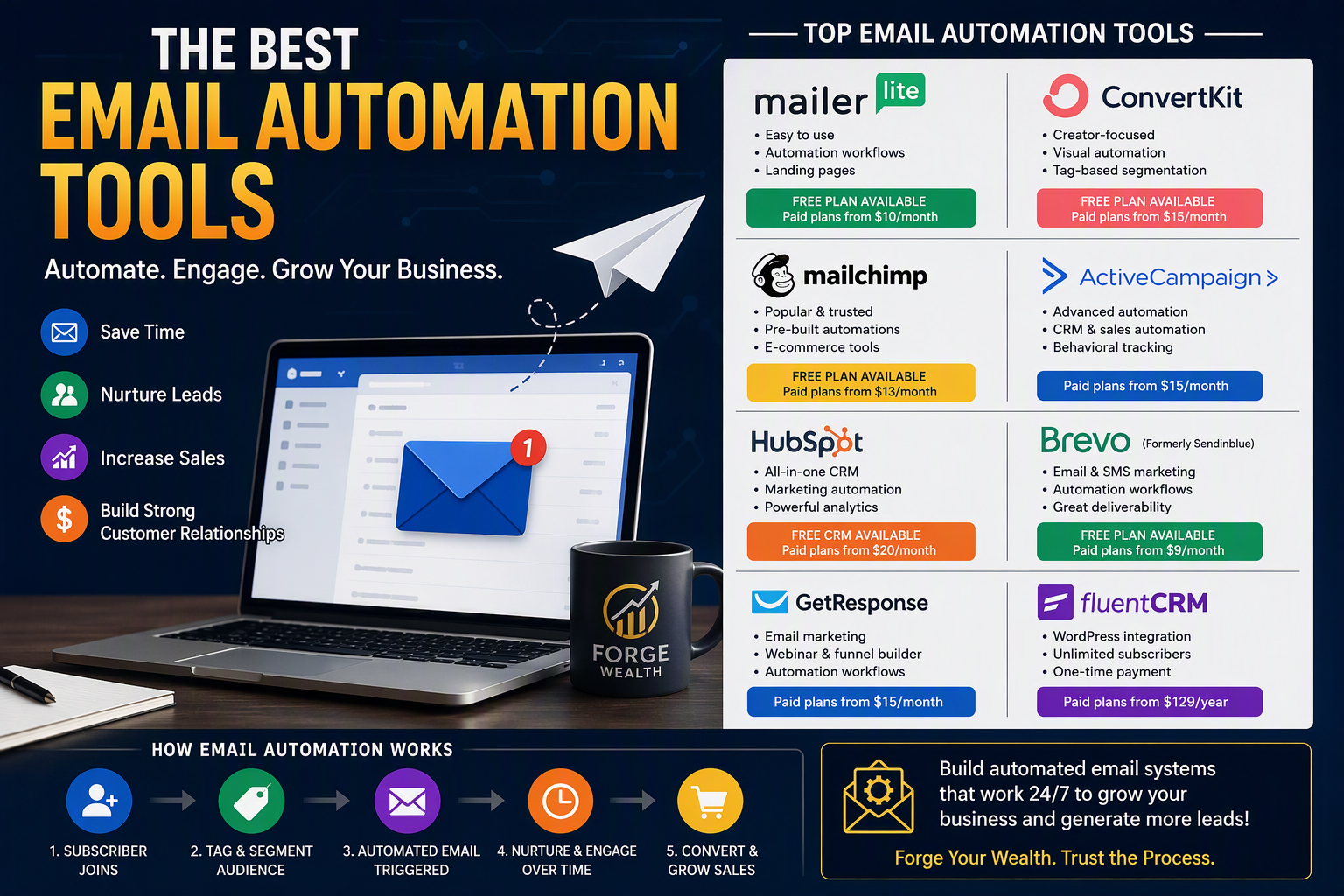
An AI-powered marketing agency combines human strategy with AI tools to deliver services such as:
- SEO keyword research
- Content strategy
- Email marketing
- Paid advertising optimization
- Customer segmentation
- Social media management
- Marketing analytics
Practical Example
Suppose a local furniture retailer wants to increase online sales. Traditionally, creating a three-month marketing campaign could take weeks.
With AI, you can quickly analyze competitors, identify high-value keywords, generate campaign ideas, and draft personalized email sequences—then refine them using your expertise.
The result is faster execution, lower costs, and a stronger return on investment for your client.
Businesses are willing to pay for measurable outcomes, making this one of the most profitable AI business ideas available today.
Related Articles
Common AI Business Mistakes That Prevent Success – forgewealth.org
The FIRE Movement Explained: Can You Retire Early? – forgewealth.org


3 thoughts on “AI-Powered Businesses: Opportunities Entrepreneurs Should Not Ignore”