

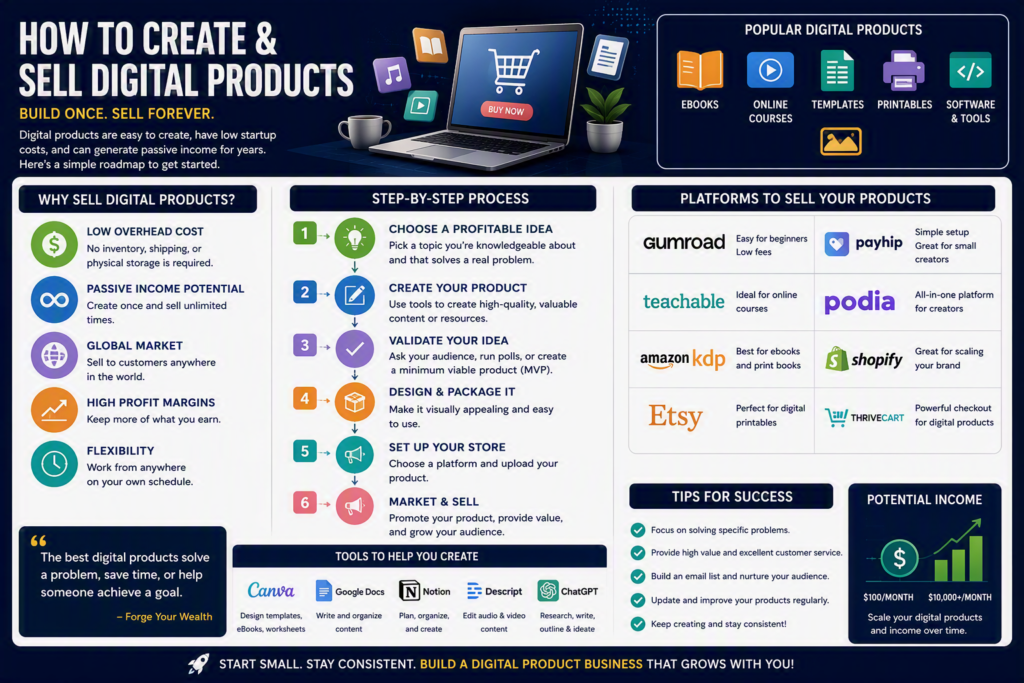
There is a reason many online entrepreneurs gravitate toward digital products. Once created, they can be sold repeatedly without stock, shipping, or restocking. Unlike physical goods, digital products scale easily. A single ebook, template, or course can be purchased by one customer or ten thousand. After the initial creation, little additional effort is required. That scalability precisely drives the appeal of digital products. It underpins a passive income and a genuinely sustainable online business.
Still, “create something once, sell it forever” makes the process sound deceptively simple. Reality shows that success depends on three steps. First, choose the right product. Then build it properly, and finally market it so it reaches buyers. This guide walks through the entire journey, from initial idea to your first sale and beyond.
What Counts as Digital Products?
Before diving into strategy, it helps to understand the sheer range of what qualifies. Digital products span far more than just ebooks, though ebooks remain a popular entry point. Other common categories include:
- Online courses — structured lessons teaching a specific skill, often through video
- Templates — resume templates, spreadsheet trackers, social media graphics, or website themes
- printable — planners, worksheets, or checklists designed for download and print
- Software and apps — tools, plugins, or browser extensions solving a specific problem
- Stock assets — photography, fonts, icons, or music for creators and designers
- Memberships — ongoing access to exclusive content, communities, or resources
- Digital art — illustrations, presets, or design assets sold individually or in bundles
What ties all of these together is that they are created once. They are stored digitally and delivered instantly upon purchase. No physical inventory is involved. That single characteristic is what unlocks the passive income potential everyone talks about.
Step 1: Choose a Product Based on a Real Problem
One major mistake beginners make is building for interest. They neglect to confirm whether others want it. Verify there is actual demand before building. A far more reliable approach starts with identifying a specific problem, then designing a product that solves it.
Start by considering your own expertise or experience. What do people frequently ask you for help with? What have you already figured out through trial and error that others still struggle with? These questions often reveal product ideas hiding in plain sight. What you think is obvious can be valuable to someone earlier in the journey than you.
Beyond personal experience, research existing demand directly. Browsing forums, social media groups, and marketplaces like Etsy or Gumroad reveals which digital products sell well. This shows what the market is willing to pay for. Notice recurring complaints or unmet needs within a niche. That gap often represents fertile ground for a new product.
Ultimately, the strongest digital products lie where you can create something valuable. They meet the questions people are actively searching for solutions to.
Step 2: Validate the Idea Before Investing Heavy Effort
Once you have a concept, resist the urge to spend weeks building it immediately. Instead, test whether people actually want it first, since validation early on saves enormous time later.
A practical approach is to build a basic landing page for the product before it exists. After that, direct modest traffic via social media or a relevant community. If people sign up for updates or express genuine interest, that’s a strong signal worth pursuing further. Alternatively, pre-selling the product at a discounted rate validates demand and funds production. Delivery is promised within a set time frame.
Another underrated approach is to ask your existing audience, however small, if they are interested in such a product. Also, determine what price feels reasonable to them. Direct feedback from real people almost always outperforms guesswork.
Step 3: Build the Products with Quality in Mind
With validation in hand, it’s time to actually create the product. The specific tools vary depending on what you’re building, but a few principles apply broadly across categories.
Keep the initial version focused rather than exhaustive. Many creators fall into the trap of trying to cover every angle before launch. That approach delays release and dilutes quality. Focus on a product that solves one problem exceptionally well. A bloated product that tries to do everything adequately tends to under perform.
Invest in presentation, since digital products are judged heavily on first impression despite being intangible. Clean design, clear formatting, and professional visuals signal quality even before a customer experiences the actual content. Tools like Canva, Notion, or dedicated course platforms make this achievable without requiring design expertise.
Test the product yourself, or better yet, have someone unfamiliar with the material go through it before launch. Gaps in logic or confusing instructions are easier to spot from an outsider’s perspective than your own. This is because you already understand the material intimately.
Step 4: Choose the Right Platform to Sell the Products
Choosing a selling channel is nearly as crucial as what you sell. Different platforms serve different audiences and provide varying levels of control.
Gumroad remains a favorite among independent creators for its simplicity, allowing you to upload a product and start selling within minutes, with minimal setup required.
Etsy works particularly well for printable, templates, and design-oriented digital products, thanks to built-in search traffic from shoppers already looking for exactly that type of item.
Your own website, built through platforms like Shopify, WordPress with WooCommerce, or a simple landing page tool, offers maximum control over branding and customer relationships, though it requires more effort to drive traffic independently.
Course platforms such as Teachable or Podia suit structured educational content particularly well, offering built-in tools for organizing lessons, tracking progress, and issuing certificates.
Marketplaces specific to your niche, such as Creative Market for design assets or Udemy for courses, can provide instant access to a relevant audience, albeit often in exchange for a larger commission cut.
Many successful creators eventually sell across multiple platforms simultaneously, but starting with one and mastering its dynamics usually produces better early results than spreading efforts too thin from the outset.
Step 5: Price for Value, Not Just Effort
Pricing digital products confuses many beginners, largely because there’s no material cost to point to as justification. Instead of pricing based on how long something took to create, price based on the value it delivers to the buyer.
A template that saves someone ten hours of work is worth considerably more than its five minutes of “download time” might suggest. Similarly, a course that helps someone earn back its cost within their first month of applying the material justifies a premium price far beyond its production cost.
That said, testing different price points often reveals surprising results. Sometimes a lower price generates significantly more volume, resulting in higher overall revenue; other times, a higher price actually increases perceived value and conversion, since customers frequently associate cost with quality. Rather than guessing indefinitely, treat your initial price as a hypothesis you’re willing to adjust based on actual sales data.
Step 6: Market the Products Consistently
Even an exceptional digital product won’t sell itself without visibility, which means marketing deserves just as much attention as the creation process itself.
Content marketing tends to work particularly well for digital products, since blog posts, videos, or social media content addressing the same problem your product solves naturally attracts people already searching for that solution. Over time, this content also builds ongoing organic traffic that continues generating sales long after publication.
Email marketing remains one of the most effective channels available, since people who’ve subscribed to your list have already expressed some level of interest, making them significantly more likely to purchase than cold traffic. Building an email list before launch, even a small one, often produces a meaningful spike in day-one sales.
Collaborating with others in adjacent niches, whether through affiliate partnerships or simple cross-promotion, can also introduce your product to an audience that already trusts the person recommending it, accelerating growth beyond what solo marketing efforts typically achieve.
Finally, don’t underestimate the power of genuine engagement within relevant online communities. Answering questions, offering helpful advice, and only occasionally mentioning your product, rather than constantly pushing it, builds trust that eventually converts into sales more reliably than aggressive promotion ever could.
Step 7: Automate Product Delivery and Sales Process
One of the greatest advantages of digital products lies in how easily the entire sales process can run without your constant involvement. Setting up automated delivery, whether through the platform you’re selling on or a dedicated tool, ensures customers receive their purchase instantly, any hour of the day, without requiring manual intervention.
Payment processing, receipt generation, and even follow-up emails thanking customers or offering related products can all be automated using tools like Zapier, ConvertKit, or built-in platform features. Once this system is in place, your digital product genuinely begins generating income while you’re asleep, on vacation, or focused entirely on creating the next offering.
Step 8: Improve and Expand Products Over Time
Launching a digital product isn’t the finish line; it’s closer to the starting point of an ongoing relationship with your audience. Pay close attention to customer feedback, questions, and any recurring points of confusion, since these often reveal opportunities to refine the product or create complementary offerings.
Many successful digital product businesses grow not from a single hit product, but from a small ecosystem of related offerings that serve customers at different stages or price points. A free resource might attract new audience members, a low-cost product converts them into paying customers, and a premium offering serves those seeking deeper value. Building this kind of ladder gradually, rather than trying to launch everything simultaneously, tends to produce more sustainable growth.
Common Mistakes to Avoid
A handful of missteps show up repeatedly among beginners entering the digital product space, and avoiding them can save considerable time and frustration.
Overbuilding before validating demand wastes effort on something that might never sell, regardless of how polished it becomes. under pricing out of fear that no one will pay more often undervalues genuinely useful work and can be difficult to correct later without upsetting early customers. Neglecting marketing entirely, under the assumption that quality alone guarantees sales, overlooks the reality that visibility matters just as much as the product itself. And treating launch day as the end of the process, rather than the beginning of ongoing refinement, causes many creators to miss opportunities for improvement that could meaningfully boost long-term revenue.
Final Thoughts
Creating and selling digital products offers a genuinely compelling path toward passive income, but “passive” doesn’t mean “effortless.” The upfront work of identifying a real problem, validating demand, and building something genuinely useful requires focus and patience. Once that foundation is in place, however, the ongoing effort required to maintain sales drops dramatically compared to almost any other online business model.
Whether you’re starting with a simple template, a focused ebook, or an ambitious course, the underlying principles remain the same: solve a real problem, build with care, and market consistently. Do that well, and your digital product can continue generating income long after the work of creating it has ended.
References
Digital Product Platforms
- Gumroad – Digital Product Creator Resources
https://gumroad.com - Payhip – Selling Digital Products Online
https://payhip.com - Teachable – Online Course and Digital Product Platform
https://teachable.com - Podia – Digital Products and Membership Business Resources
https://www.podia.com - Amazon Kindle Direct Publishing (KDP) – Self-Publishing Platform
https://kdp.amazon.com
Entrepreneurship and Business Resources
- Shopify Blog – How to Create and Sell Digital Products
https://www.shopify.com/blog - HubSpot – Digital Marketing and Online Business Resources
https://www.hubspot.com - Forbes – Creator Economy and Digital Business Insights
https://www.forbes.com - Harvard Business Review – Digital Business Strategy
https://hbr.org - U.S. Small Business Administration (SBA) – Small Business Guidance
https://www.sba.gov
Creator Economy and Online Income
- ConvertKit (Kit) – Creator Business Resources
https://kit.com - Patreon – Creator Economy Insights
https://www.patreon.com - Stripe – Online Payments and Digital Commerce Resources
https://stripe.com - Statista – Digital Commerce and Ecommerce Statistics
https://www.statista.com - World Economic Forum – Digital Economy Research
https://www.weforum.org
Related Article
AI Technology Which Careers Are Safe in the Age of Automation? –